A new book which I am sure will be of interest to readers of this blog is Letters to Friends of the Spirit. Written by Rémi Boyer and his wife, Sylvie, it represents two series of 22 letters (no coincidence, of course) adding to 44 letters in all. These letters, each no more than 2 – 4 pages long, were written during the time of confinement due to Covid. While the US endured a confusing number of different approaches to the pestilence, in France there was a country-wide lockdown and curfew which lasted for many months. This was seen my many as a source of frustration and bitterness; but to those of a spiritual nature it offered a unique opportunity to put into practice what so many of us claim to do: meditate on the precious teachings given to us and draw new conclusions, insights and correspondences from them.
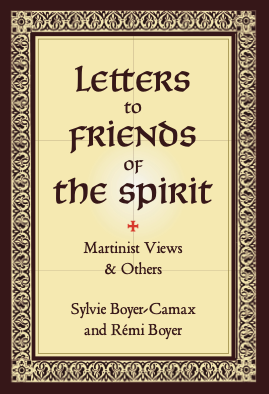
I was particularly taken by the title Letters to Friends. For Martinists, this certainly recalls the significant correspondence undertaken by its leaders, for example, Pasqually to Willermoz, and the latter to Prince Christian von Hesse; and the Theosophic Correspondence between Louis-Claude de Saint-Martin and Baron Kirchberger has been in continuous print in English since 1863. All these letters were written with the intention of educating, clarifying, debating and developing points of religion, theosophy, ritual and theurgy: so it is particularly appropriate for a new series of letters, this time written to many people around the world, covering topics which include Martinism, Masonry, Gnosticism, Pythoreanism, Rose-Croix and other field should go back to the traditional form of education, at a time when our inability to travel far put us in a similar situation to the days of the 17th and 18th Centuries, when travel was an expensive luxury undertaken by the few.
The style of the Letters to Friends also recalls the manner in which Saint-Martin laid out his thoughts and aphorisms in short, individual sections. Think of Homme du Désir, with its many segments covering a variety of ideas, each with its own suggestive title. However, I would point out that unlike Saint-Martin’s obtuse and often difficult use of language, these letters are clear and easy to follow. Indeed they can sometimes be deceptive in their apparent simplicity, until one ponders the message behind the words. This advantage also means there is no need to be well-versed in history or deep esoteric teachings in order to take away a great deal of wisdom from these letters.
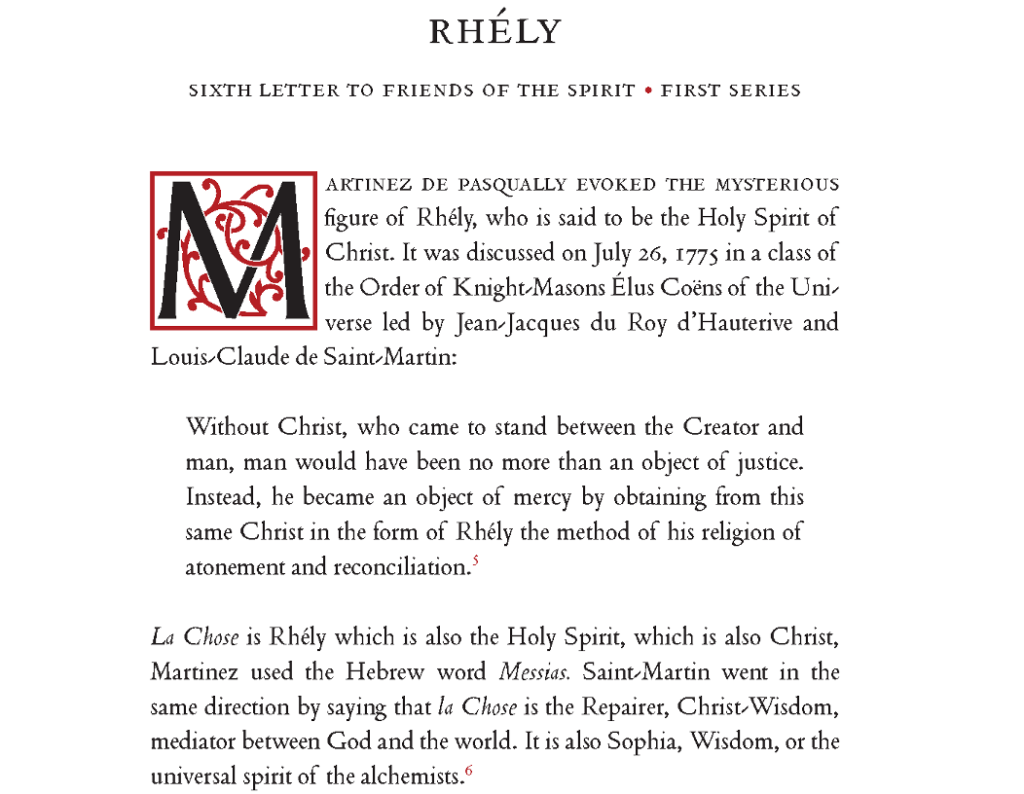
The topics covered in this excellent volume are many and varied. Many are clearly Martinist-Martinezist in nature, which means that a key theme will be a gnostic approach to Christology; Hebrew Letters form a basis for analysis and meditation; Chivalry in all its forms, from a discussion on arms to the notion of ‘the Lady’ are just a few of the subject the Letters to Friends engage. Of course discussions of the Spirit in many aspects feature prominently in these letters. What is especially pleasing is that the short length of each letter allows it to be read in its entirely in one sitting, and the contents mused upon, or even read prior to sleep to see if any lucid dream shines further illumination on these words. For we must not forget that these are mature musings of two people who have been steeped in these traditions for many decades, and not the fevered imaginings of some enthusiastic youth (remembering that Saint-Martin was only 25 when he wrote Of Errors & Truth – and it shows!).
The book is not inexpensive. It is in itself a beautiful work of art in hardback, and it created to endure. For me that is fitting as it is meant to be a book which sits on the side table to be perused and dipped into many, many times, as a source of inspiration and a contemporary vade mecum of Martinist thought. With a Foreword by Guy Thieux, the renowned author and radiesthesiologist, I commend this book to all those – Martinists and otherwise – who seek to read the living words of contemporary practitioners of the Path of Mystic Christianity.
