I was quite surprised when I first saw the title of this book. The word ‘Rosicrucian’ brings a number of thoughts to mind. A spiritualized form of Christianity. A system built on Spiritual Alchemy, Hermeticism and the Kabbalah. An allegory of reintegration. A series of political pamphlets espousing a Protestant outlook. Perhaps even an intimation of a secret society which has persisted behind the scenes throughout the ages. Certainly, a perhaps mythical Order which nevertheless has inspired many imitations and an abundance of would-be successors through the centuries.
But the word ‘death’ had never come to mind before, except as a passing phase of the alchemical process.
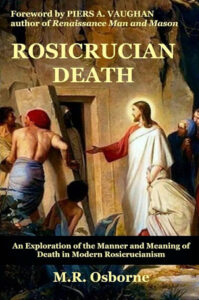
However, reflecting on the title, even before opening the book, I was prodded to think about this aspect of Rosicrucianism. And indeed, I realized that death is indeed a central nexus in the Rosicrucian story since, like Da’ath on the Tree of Life, there is a veil to be passed before the promises alluded to in its stories can be experienced. All Rosicrucian teaching is preparatory to this moment. All the lessons are dedicated to understanding our current state, how we came to be here, how to find the Path of Return, how to remain steadfastly upon it, and how to reach the Gate through which one may achieve union with the Source.
With this image clear in my mind, I now turned to the book, curious to discover how the author was going to approach this difficult subject. My greatest fear was that it would be a turgid theoretical tome, citing endless books, and basing itself entirely on an academic analysis of existing theories.
So, I was most pleasantly surprised to discover that, far from realizing my prejudices, it was a refreshing and practical book which wished to examine the practical aspects of the journey to the Source, and was not afraid to use any source of information, be it scientific, philosophical or experiential, in order to explore this topic.
The narration is bound together by the author’s personal experience surrounding the sudden passing of his father-in-law. This both cements the personal nature of the journey through the various aspects of Rosicrucian death examined in the book, and brings a poignant immediacy to the text. It would have been easier – and probably less painful – to simply illustrate each idea with an impartial and neutral example. However, this opening up makes the read all the more compelling.
The work begins with a significant Introduction of some sixteen pages, in which the author discusses the two aspects of Rosicrucianism as an inner, mystical school; and a more Hermetic and theurgical path. Regardless of whether the original manifestos suggested a Protestant wake-up call or a mystical alchemical College, its enduring history has tended to follow one of these two paths, and many Orders and Societies have arrogated the name ‘Rosicrucian’ or ‘Rosy Cross’ to attract members and to hint at their activities. The common aim is personal development and a rising through the planes to achieve a closer union or even complete reintegration with the Source. Whether this is best accomplished by personal, internal transformation or through the practice of ritual will probably depend upon the individual: while some have sufficient inner motivation for personal work, the majority will probably need to support of an external structure and a manual of instructions, maintained by a support group of some kind, be it a church or an Order. In his exegesis the author points to remarkable similarity in the respective symbolism of the tomb of Christian Rosenkreutz and that of Lazarus in the New Testament.
Beginning with the transition of a person from the living state, the author first considers the possibility of residual energy remaining behind, and if so, for how long, before going on to consider the transforming quality of grief, that emotion experienced by those who are left behind once that person departs for the unknown realm.
Death can also be seen as an alchemical process, and this is explicitly demonstrated in the Chemical Wedding. Using this analogy, it is possible to regard the stages of the body immediately post-death in a similar light and consider what happens both to the body, and the being which occupied it in the hours and days post-mortem. In Rosicrucian symbolism this naturally leads us to the Tomb of Christian Rosenkreutz, its ne plus ultra symbol. As Jesus left the womb to live on earth, and was then stretched upon the cross which folds back into itself to form his tomb, before releasing him back into second life, so the Tomb containing its uncorrupt body reminds us both of Lazarus, as stated above, and the Tomb of Christ, with the implication that it is through this channel that we all must pass in order to be reunited with our origin.
Here the author takes time to consider various movements and key characters in the Rosicrucian movement, and also revisits Shakespeare’s monument in Stratford-upon-Avon, to consider its Rosicrucian themes.
It is at this point that the book takes a distinctly more daring approach!
Up to now we have meandered along safe paths, reviewing history, discussing famous Rosicrucians and debating some of the ideas arising from Rosicrucian and Hermetic ideas. But now we find ourselves moving in a far more practical direction. The next chapters consider the physics of death and what this implies about an afterlife. We find ourselves discussing medical definitions and theories across various cultures, and touch on quantum uncertainty, dark matter and string theory from modern physics as avenues for exploration; as well as Kirlian photography and ESP from the realm of parapsychology; and even consider the effect of mind-altering drugs as a possible avenue to experience some of these transformations. In all these instances the author continually compares the results and experiences with the descriptions of earlier philosophers and mystics, asking the provocative question: “isn’t this exactly what they were describing?”
The author ends with a consideration of the ethics of suicide in a situation where a mystic might believe he has learned enough of this world and is ready to pass on to the next; and finally the question of the ‘glorious body’, the form we take on when we transition, its possible composition, and what it means to have a ‘good’ death.
The book intrigued me because it attempts to draw together both mystical and scientific threads to weave a holistic approach to death and what takes place afterwards. It provides many intriguing ideas and food for thought, and, while it is not always successful – how could a first book in this vein cover every possible angle? – it is a bold adventure well deserving of a considered read. I applaud the author for taking so bold an approach.
