Alchemy and Spiritual Healing have long had a close association. We read of the Rosicrucians that their first duty was to heal, and that gratis. And at the same time we know that they were devoted to alchemical studies, and the Vault of Christian Rosenkreutz, when rediscovered, was found to contain many alchemical teachings, including a ‘spiritual sun’ which illuminated the room as if by magic.
It is not really surprising that alchemy and healing come from the same root. After all, one of the two stated objectives of alchemy is the creation of the Elixir of Life, a liquid which can prolong life and heal illness.
But can we find anything similar in the Exemplar to the Rosicrucians, the Christos?
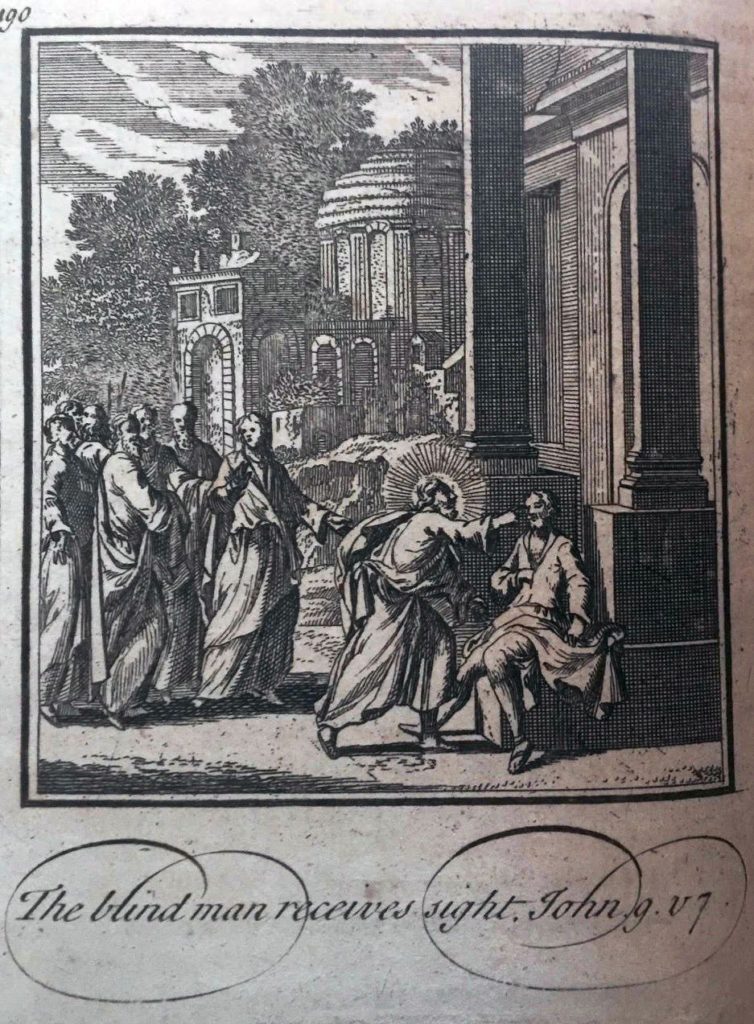
It is interesting to note that two consecutive Chapters of the Gospel according to St. John contain two phrases of immense importance to Rosicrucians and Alchemists alike. In Chapter 9, verse 5 Jesus says: “I am the light of the world.” Immediately following this statement he heals the blind man. In verse 25 the blind man declares to the Pharisees: “I was blind, but now I see.”
These are two of the most important statements in Rosicrucian thought.In these phrases we of course see symbolic light being conferred. The man is not only literally but figuratively blind. In the description of Louis-Claude de Saint-Martin, he is a ‘man of the stream’, living in the ‘Forest of Errors’. Only be opening his inner vision does he realize how to redeem himself. Jesus helps him to see the truth.
But how does Jesus accomplish this. The manner is most interesting.”He spat on the ground, and made clay of the spittle, and he anointed the eyes of the blind man with the clay.” In other words, he took what might be considered ‘prima materia’, the base substance which is the substrate used by alchemists, a substance made of Earth, Water and Air, and brings it to life by introducing his living essence, Fire, into it, thereby bringing the clay to life. This he uses to effect a healing. Is this not similar to the description in Genesis Chapter 2, verse 7: “And the Lord God formed man of the dust of the ground, and breathed into his nostrils the breath of life; and man became a living soul.”
See the similarity. In both cases clay or a base substance is used or alchemically manipulated and life, or the divine spark of fire, in the form of breath or spittle, is introduced.
Perhaps we should not be so surprised to see this action taking place in the macrocosm and the microcosm, each having its own effect within its relative sphere of influence! Thus the Old and New Testaments give us both action and symbolism to make its point, and display both practical and spiritual alchemy.
However, we find an intermediate step if we look at the Good Book closely enough. For Catholics it will be in the general section of the Old Testament; Protestants will have to find a Bible with an Apocrypha still intact in it.
If we look at the Book of Tobit, In Chapter 10, verses 7 and 8, we find the Archangel Raphael instructing Tobias how to remove the blindness of his father by anointing his eyes with the gall of a fish. It is interesting to note that, while Raphael features extensively in the book as both guide/psychopomp and healer, he takes pains to point out that he is insubstantial, and that he neither took food or drink nor physically touches anyone during the adventures; but taught Tobit’s son how to use the medicament to effect the healing.
A phrase in Martinism points to the fact that man was placed by God above all other creatures and Orders, notwithstanding he was created long after them. And this refers both to animals and angels. So can we infer that God and man alone can heal?
In a later segment we will consider the phrase “I am the Light of the World” in the context of St. John Chapter 10, verse 9, where Jesus says: “I am the door: by me if any man enter in, he shall be saved.” This again leads to a profound esoteric and Rosicrucian conclusion!
