Masonic

Mad, Bad and Dangerous to Know

By March 13, 2017March 15th, 2017No Comments

A good friend of mine, Robert L. Barrows, now sadly deceased, used to use a phrase which delighted me: “Once Masons were mad, bad and dangerous to know. Nowadays we have become ‘fluffy’.If we want to be taken seriously on the world stage again, we need to rediscover our roots.”

When I first started to give talks, a number of older Masons asked me why I taught all this symbolic and esoteric
‘nonsense’. Why did I project things onto what was, after all, nothing more than a fraternal society founded to provide mutual support and fellowship, and have a little fun?

Well, I have news for those Masons who think the Craft is little more than a society of charitable donations and clam bakes!

Meet Jean-Baptiste Willermoz, a prominent French Mason in pre-revolution France. We will encounter him many times on these pages. For now, let us be content with the fact that he was a prominent businessman and Freemason living in Lyons in the latter years of the 18th Century, who wrote many rituals and developed many Masonic systems based around the early Scottish Rite. In his well-researched book on the history of the Scottish Rite, A. C. F. Jackson tells us that Willermoz was responsible for the Rose Croix, or 18th Degree of the present-day Scottish Rite system. But let us consider for a moment another of his rituals.
Firstly, let us remember that, while the only inconvenience faced nowadays by a Candidate in the Preparation Room prior to receiving his First Degree is the injunction to turn off his smart phone and change into slightly creased and dirty clothing; in those days the prospect of handing over one’s sword to a complete stranger and to wait in a room without any means of defense was terrifying to a person who might face death from robbers every time he simply had to walk down an alley. Now imagine this scenario, from the Knight of the Black Eagle Rose Croix, which you can see below written in Willermoz’ own hand:
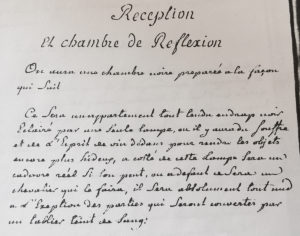


RECEPTION INTO THE CHAMBER OF REFLECTION
“There should be a black chamber prepared in the following manner:
“This will be a room completely hung with black curtains. Lit by a single candle, or a lamp with sulfur and alcohol to make the objects in the room even more hideous, next to the lamp should be a real cadaver if possible; or if this is not possible a Knight to substitute. He or it is to be completely naked except for those parts which are covered by an apron stained with blood.”

Wow!

 Later in the ceremony the candidate is introduced to a number of invocations, sigils and magical signs, including as an example the two below: the Seal of Plato, who is associated with Venus, Copper and the Genie Hagith; and one of the secret Seals of Solomon, King of Israel.
[vc_single_image image=”156″ img_size=”medium” alignment=”center”]
[vc_single_image image=”157″ img_size=”medium” alignment=”center”]

So the next time you hear a senior Mason telling someone that Freemasonry is nothing more than an excuse to get together, eat, have some fun and give a little to charity, read them the passage above and show them the sigils used in a regular Lodge at the end of the 18th Century!

Piers Vaughan

Piers Vaughan was born in Brighton, England, and following sojourns in Germany and Switzerland, lives just outside New York City. He was educated at Brighton College, Oxford and Cranfield Universities, and holds M.A.s in Psychology and Divinity, and an M.B.A. He worked in banking for most of his life, as a Project Manager and Internal Consultant in IT and Operations, later acting as COO of a small training company based in New Jersey. He has been a Freemason most of his life, and is a member of St. John's Lodge No. 1 in New York, which was founded in 1757, and is the guardian of the George Washington Inaugural Bible. He is a 33rd Degree Mason in the Ancient Accepted Scottish Rite, and a Past Grand High Priest of the Grand Chapter State of New York, Royal Arch Masons, which he currently serves as Grand Treasurer. He is also a long-standing member of a number of esoteric Orders, having helped to bring a number of these to the United States from England and France. He is also Primate of the Apostolic Church of the Golden & Rosy Cross, a descendent of the Pre-Nicene Church of Richard, Duc de Palatine. He has a particular interest in the Orders, Rituals and protagonists of 18th Century French Masonic and Esoteric Orders, and has built a reputation translating many source documents into English, and lecturing around the world on these topics.

Leave a Reply

This site uses Akismet to reduce spam. Learn how your comment data is processed.