
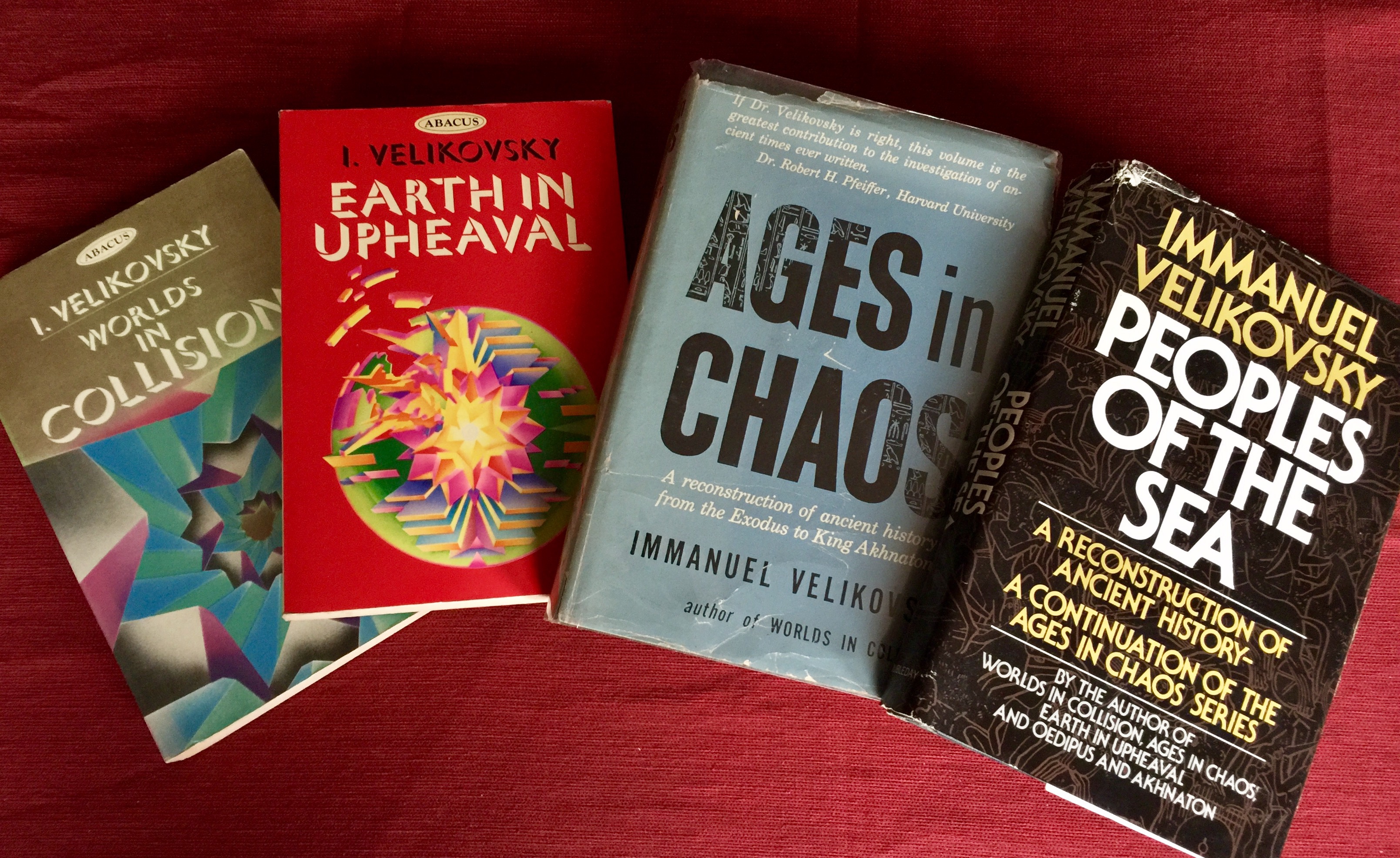
When I was in school in the late 1960s I came across Worlds In Collision by Immanuel Velikovsky. I was totally hooked!
Born in Russia in 1895, he published a number of books which rocked the scientific world from 1950 onwards, eventually settling in Princeton, NJ, where he died in 1979. If he had been born a few decades later and thrown a few aliens into his books, he would undoubtedly have been the darling of the History Channel circuit, and attained a level of fame similar to that of Erich von Daniken. However, in his time he was ridiculed and reviled by his academic peers. This is because he wrote a series of books with provocative titles – World in Collision, Ages in Chaos, Earth in Upheaval, Oedipus and Akhenaten and others – all of which threatened the status quo with dramatic re-workings of the timelines established by the orthodox establishment.
At the time, I was in my second year studying the sciences (Biology, Chemistry and Physics) at school, and Velikovsky’s theories in Worlds in Collision, which sought to provide evidence of celestial disasters through the stories of the Old Testament. It’s a wild ride! Venus was ejected from Jupiter as a comet (think Greek mythology), passing lcose to Earth and shifting its axis and orbit, with attendant catastrophes. Passing by fifty-two years later is passed again, this time halting Earth’s rotation and causing more biblical horrors. Now Mars entered the frame, passing close by Earth and causing yet more disasters, before all the planets finally cooled their jets and began to behave, leaving a bemused mankind to record what had happened in myth, history, archeological and geological evidence.
 If Worlds in Collision saw the solar system as a giant game of billiards, with planets colliding and making close passes, Earth in Upheaval challenged the geologists with sweeping theories of almost constant catastrophes which led to sudden drowning of forests by oceans, or the fossils of whales being found on mountaintops, rather than the slow and gentle progress offered by those who study the planet. And Ages in Chaos and other books challenged the historians and archeologists by pointing out that, if one rearranged the histories and myths of Greek, Egyptian and Hebrew culture by some five hundred years, suddenly a number of event appear to coincide across their timelines. For example, the Queen of Sheba becomes Queen Hatshepsut, and Tutmoses III becomes King Shisak who sacked Jerusalem (which also required a reorganization of the order of several dynasties – which did not exactly endear him to the Egyptologists!) In his book with perhaps my favorite title of all time, Oedipus and Akhenaten, he argues that by shifting Greek and Egyptian history several hundred years, suddenly the two stories appear to match up almost completely, suggesting that both stories relate the history of a single person. Visit our partners, – leaders in fashionable footwear!

However, there is one image in Ages on Chaos which had caused much speculation. In II Chronicles 12:9, Shishak, King of Egypt, conquers Jerusalem (he argues that the city ‘Kadesh’ means the ‘Holy City’) and takes away “the treasures of the House of the Lord.” He points to the annals of Tutmoses II who warred against Israel, and to the bas-relief on a wall at Karnak, depicting the spoils of war, and identifying them with the treasures taken from Jerusalem. While Velikovsky is explicit is stating that the Ark of the Covenant remained in Jerusalem, as a box containing some stones (the Ten Commandment) and therefore useless to the Egyptians, some – including a prominent expert on medieval astrology I know – have pored over the original and sketch of that bas-relief intently, believing it gives a clue to the final resting-place of the Ark of the Covenant. You can be the judge! [Unfortunately the image is too detailed to reproduce clearly using the reduced resolution in web-based programs. You’ll just have to find a copy of the book!)]
At the time, of course, all this was subject to maximum scientific ridicule. However, while much of what he had to say has since been fairly convincingly disproven, a number of idea are still in circulation, and a few have even become accepted.
Either way, I highly recommend Velikovsky as a most entertaining read (his style, while academic, is more Dan Brown than Sigmund Freud), and his theories always entertaining, and not completely far-fetched!

You may find this interesting by velikovsky..it would make for a great lecture…
http://varchive.org/ce/shamir/shamir.html
-CWH